
Euclid Resident Lookup Coverage
An Euclid resident lookup is a verification task, not one master search. Euclid MyPlace results can connect a recorded owner to a parcel. The Cuyahoga Recorder can connect parties to an instrument affecting an Euclid parcel. Euclid voter records can display public registration facts subject to statutory exclusions. Euclid court and Probate dockets are case locators, while Euclid vital and library sources document events or historical leads. Each Euclid record confirms a narrower fact. Use at least two compatible sources when the same name could belong to more than one person.
| Record | What It Confirms | Where | Access |
|---|---|---|---|
| Euclid MyPlace property card | Recorded owner and Euclid property linkage | Cuyahoga MyPlace | Owner, address, parcel, and map search |
| Euclid Recorder instrument | Party, document, and property transaction link | Official Records Search | County states 1810-present coverage |
| Euclid voter registration | Public registration and precinct facts | Ohio Voter Search | Required fields and protected-record exclusions |
| Euclid court docket | Case, caption, and date pathway | Euclid Municipal Court | Scope varies; some files need the counter |
| Euclid marriage or vital record | Event or license trail | Cuyahoga Probate | Custodian procedures and statutory limits |
| Euclid credential detail | Official credential facts | Ohio eLicense | Not proof of a current residence |
For an Euclid address question, begin with MyPlace and compare the parcel, transfer date, and document trail. For an Euclid eligible-elector question, use the voter service with the required fields. For an Euclid case or estate question, start with the right court. A result that does not match the non-sensitive identifiers should be set aside rather than forced into an Euclid resident lookup.
Confirming Euclid Resident Names
The same-name trap is common in an Euclid resident lookup. An Euclid property card may show an owner name and a situs address, but it does not identify every person who lives there. A mailing address, where an underlying Euclid record shows one, can differ from the situs address. An Euclid court result can have a matching name but a different case number, party role, or date. Preserve the non-sensitive keys that the record provides: parcel number or legal description, transfer date, case number, municipality, document type, or party role.
MyPlace lets an Euclid searcher select City and then Owner, Parcel, or Address. It also offers an Euclid parcel map, Transfers, and a document-list path. Its own notice says the public-service data are not the official public record, so the originating custodian remains authoritative. The Recorder’s advanced search supplies party, grantor, grantee, date, document type, parcel, address, volume, page, and legal-description criteria. That makes it a useful second source after an Euclid parcel has been identified.
- Euclid MyPlace: Parcel ID, owner name, street address, city/state/ZIP, and property fields.
- Euclid Transfers: transfer date, deed type, volume/page, grantor, grantee, and related parcel details.
- Euclid Recorder index: party role, document type, recorded or instrument date, number, parcel, address, and legal description.
- Euclid voter record: public registration, precinct, and related public facts, subject to exclusions.
- Euclid court docket: case number, caption or party, case type, hearing or entry dates, and docket entries.
Note: A recorded owner is not every Euclid resident, and a matching name without a second record is not enough to identify a person.
Euclid Resident Lookup Court Fields
Euclid Municipal Court maintains local traffic/criminal and civil docket forms for Euclid cases. The public docket menu permits an Euclid court-date search by name, date, time, or case number. The traffic/criminal form accepts a case number, defendant last name, first name, middle initial, date range, attorney State ID, community name, and sort choice. The Euclid civil form accepts case number, case name, party name, hearing dates, and a sort choice. No Euclid docket result was opened for the research, so result facts, document images, charges, and case-date coverage should not be assumed.
| Case Number | Optional basic search field on the traffic/criminal docket. |
|---|---|
| Defendant name | Last name, first name, and middle initial are optional advanced fields. |
| From and To Date | Optional month, day, and year controls. |
| Community Name | Optional dropdown, with choices not captured in research. |
| Sort By | Date/Time, Last Name, or Case Number on the traffic/criminal form. |
Use an Euclid case, name, or date to locate an event, then ask the Euclid court counter, phone, or email about an actual file or copy. The Euclid Municipal Court links dockets, payments, and forms. Its posted location is 555 E. 222nd Street, with weekday hours of 8:30 a.m. to 4:30 p.m. Euclid case information is not a substitute for an identity conclusion.
The Cuyahoga Clerk case-search gateway has separate civil, criminal, foreclosure, and appellate search routes for an Euclid name when that court is the custodian.
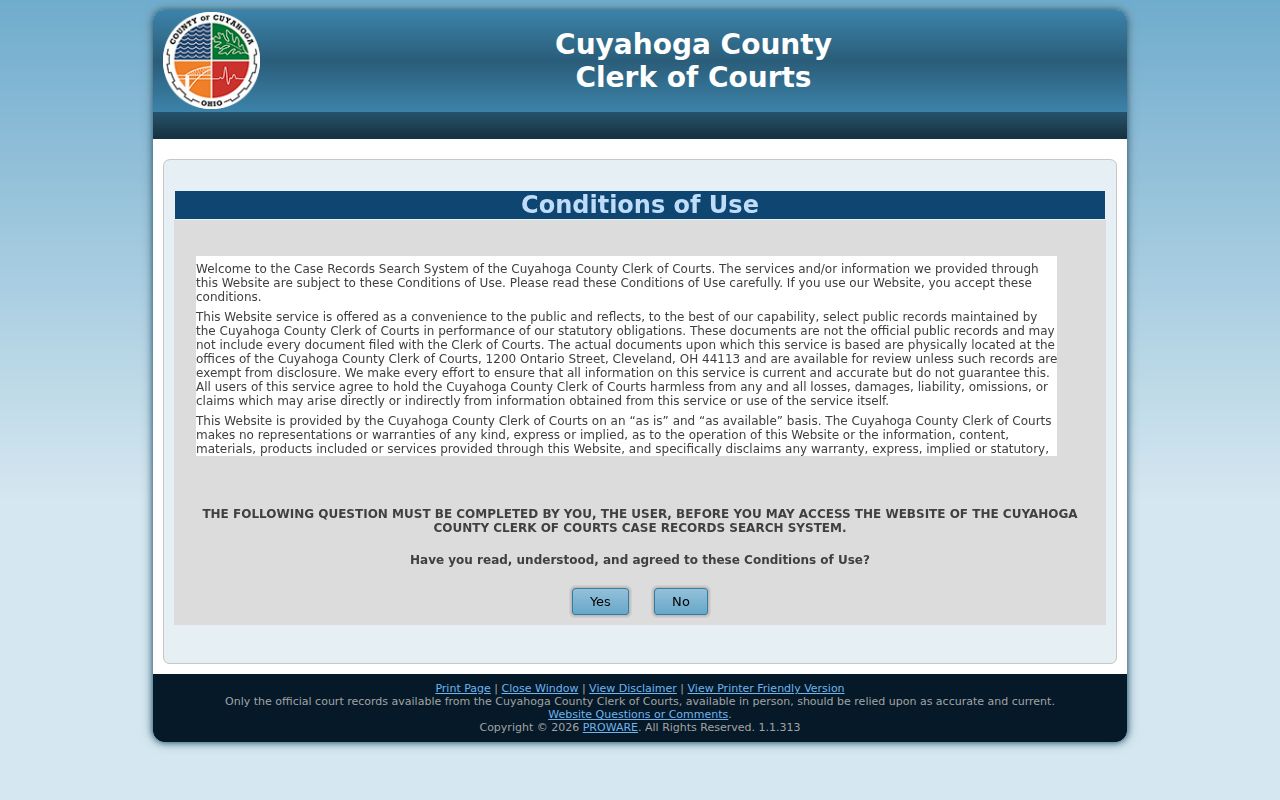
The county gateway is relevant when a Euclid name is tied to Common Pleas, Domestic Relations, or appellate custody rather than the municipal docket.
Euclid Resident Lookup Voter Fields
Ohio Voter Search requires first name, last name, and county. Choose Cuyahoga for an Euclid search. The service may then offer a street-name dropdown to narrow an Euclid result. Search guidance allows a derivative first name, a former surname, or a prior Ohio-county address when appropriate. A failed Euclid search should lead to a careful second attempt or Board contact, not a statement that someone is unregistered.
| First Name | Text, required; a derivative name may help. |
|---|---|
| Last Name | Text, required; try a former surname where appropriate. |
| County | Dropdown, required; choose Cuyahoga. |
| Street Name | Conditional subsequent dropdown for narrowing. |
| Submit | Runs the voter-registration, precinct, and polling-place inquiry. |
Ohio R.C. 3503.15 makes registration records public subject to listed exclusions. The public web result may include an Euclid name, birth date, current residence address, precinct, registration date, voting history, and last activity, but protected data are excluded. Voting history shows participation and ballot type, not ballot choices. The Cuyahoga Board’s own tool uses last name and date of birth and advises a space instead of a hyphen in a hyphenated surname for an Euclid query.
Cuyahoga voter information is the source for its county lookup instructions affecting Euclid voters.
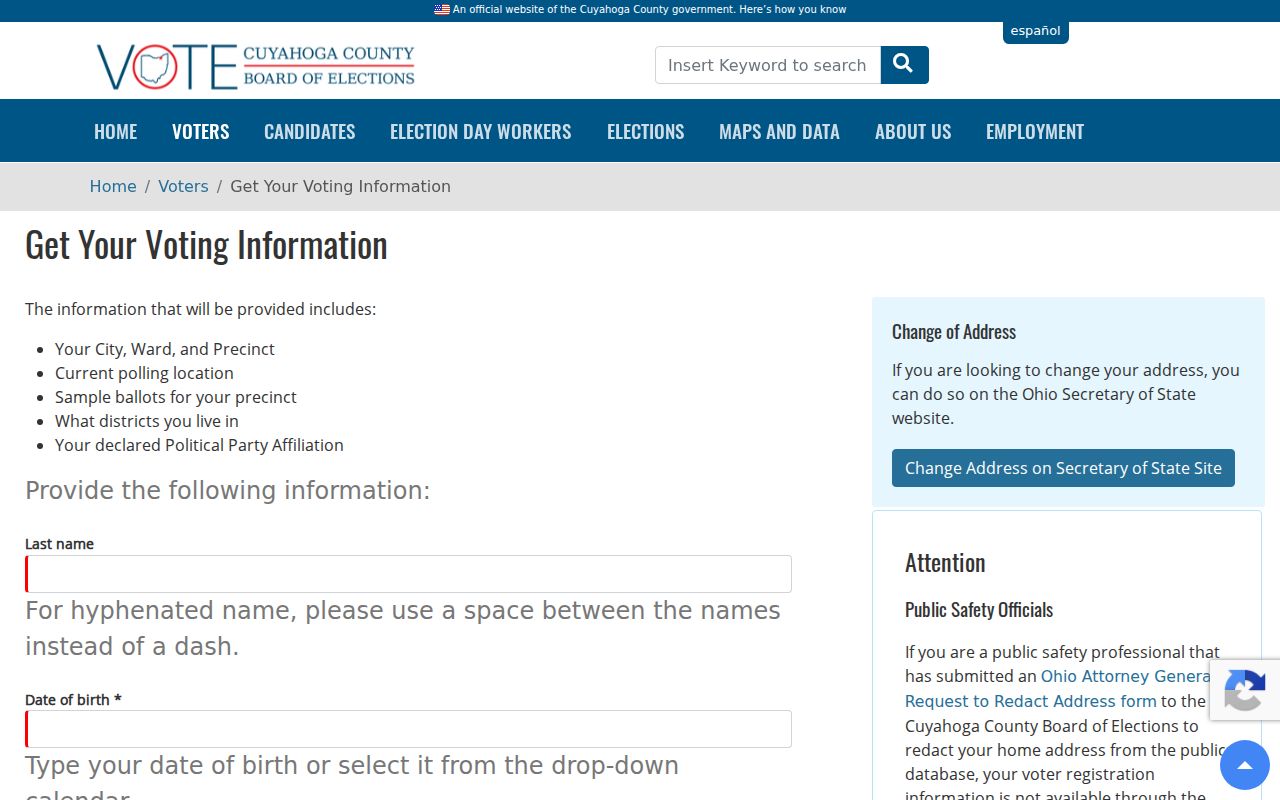
The county lookup illustrates why an Euclid resident lookup should use the required fields and respect records excluded from public display.
Verify Euclid Resident Records
Euclid verification means connecting a name to the right record, then checking another official source that answers a different question. For an Euclid name-to-property question, run a MyPlace owner search with City set to Euclid, open a parcel only after other public details match, and use Transfers and the Recorder to confirm the document path. For an Euclid voter question, use the official service only within statutory limits. For an Euclid historic name, shift to directories, released census material, obituaries, and Probate records that fit the era.
- Write down the Euclid name variation, city, and one reliable record detail, such as a parcel or case number.
- Search the Euclid official custodian most likely to carry that detail, not a general name list.
- Compare a second Euclid record type, such as a Recorder instrument after MyPlace or a court docket after a voter result.
- Keep the Euclid source date, document number, parcel ID, or case number with the result.
- Request an Euclid copy from the custodian only when the underlying record is needed.
- Docket
- A case index that identifies a case, parties, dates, and entries. It may not provide every file document online.
- Index and image
- An index helps locate a record. An image is a view of the underlying document or a linked page, when the custodian makes it available.
- Certified copy
- A copy authenticated by the custodian for a record that requires official certification. It is different from an ordinary search result.
An Euclid resident lookup can end with an archive or counter visit. That is a normal result when remote documents are restricted, an older volume has not been digitized, or a source is held by another custodian.
Euclid Resident Lookup Vital Channels
Euclid’s Vital Statistics Office is permanently closed. The city directs current Euclid birth and death requests to the Cleveland Office of Vital Statistics, while Cuyahoga Probate keeps Euclid marriage-license records. Cleveland issues certified birth certificates for people born anywhere in Ohio and death certificates for Cuyahoga County deaths except Lakewood and Parma. The research reports Cleveland’s stated $25 fee and a 2-4 week mail estimate for those requests. A signed application and fee are generally required under Ohio R.C. 3705.23, subject to the statute’s exceptions.
Do not apply a generic 100-year birth and 50-year death closure rule to Ohio records. The research found no such statewide blanket closure for an Euclid vital question. The restricted medical-and-health-use part of a birth record has its own rule, and a decedent’s Social Security number is restricted for the first five years except for authorized requesters. Ohio History Connection’s death index is a historical lead, not a certified-copy service.
Euclid marriage licenses after January 1, 2001 can be viewed through the Probate search, while earlier Euclid records are viewed at court. A certified marriage copy requires both applicants’ names, including a maiden or prior name, plus a date or approximate year. Probate posts a $2 fee for each certified marriage copy and a two-week mail turnaround.
Note: Vital and marriage evidence confirms a documented event or license route, not a current Euclid residence by itself.
Euclid Resident Lookup Probate Limits
Probate Court handles Euclid estates, guardianships, marriage, adoption, name change, and related cases. Its web docket can locate an Euclid case number and show an image associated with a docket entry, but its portal requires terms acknowledgement and permits personal use while barring commercial use, robots, and data mining. The court says its official record must be independently verified. An Euclid probate case can identify an estate or fiduciary process. It does not establish every relationship or current address without reviewing the actual court material.
Regular, certified, and exemplified Probate copies have different procedures and fees. The research lists a regular photocopy at $2 through 19 pages, then $2 plus ten cents per page after 20; certified copies at $2 per page; and full case copies at $10. Domestic Relations remote access also has limits. The public general docket is remote, but case documents are restricted to parties, lawyers of record, and appointed participants under the local rule, with direct file access through the Clerk.
Ohio eLicense can verify a public credential with a selected board and a last name plus first initial or a complete credential number. Its detail can show the credential holder, status, board, type, number, dates, city/state/country, and Board Action. These are credential facts, not proof of a Euclid resident’s present address.
Ohio eLicense is the source for the board-filtered credential lookup.
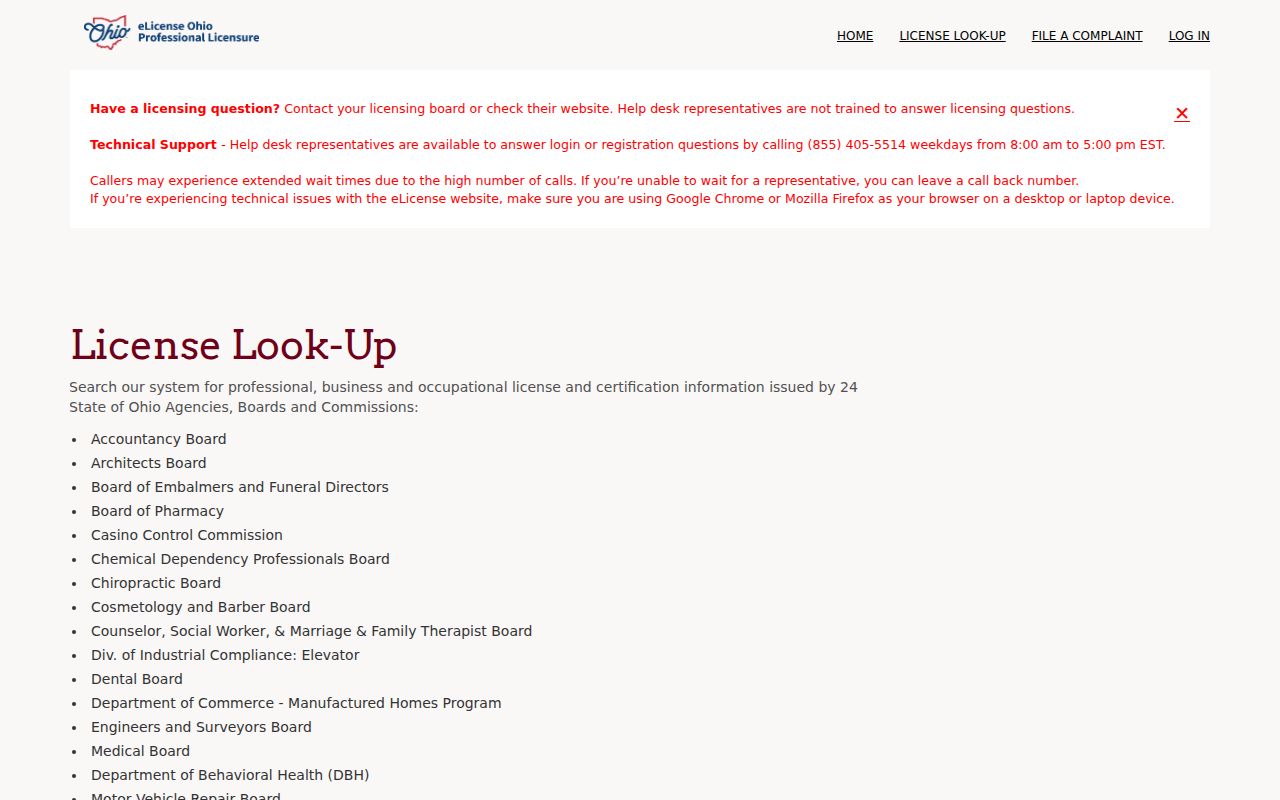
The credential screen is best used to verify a license fact, while a Euclid resident lookup needs a separate address or court source.
Euclid Resident Lookup Privacy Limits
Ohio Safe at Home is the address-protection program most likely to limit an Euclid resident lookup. Eligible participants and qualifying household members can use a substitute address for registration and government correspondence. A participant’s residence address and precinct are excluded from public statewide voter data and official lists, and the name does not appear on the public pollbook, poll list, or public database version. A missing result can reflect a statutory protection, a different custodian, a stale record, or an ordinary mismatch.
Ohio R.C. 111.43 also provides a property-record mechanism after compliant notice. County recorder, auditor, treasurer, and engineer offices should not disclose participant-identifying information together with a legal description, parcel number, or street address. Ohio R.C. 149.45 gives qualifying people an online-redaction path through the custodian. A correction or redaction request goes to the office that holds the record. City Hall does not control county property, state voter, Probate, or federal court data.
Lawful personal use. Use Euclid public records for a legitimate personal purpose. Ohio law prohibits stalking and harassment, and an official record must never be used to intimidate, monitor, or harm anyone.
Euclid Resident Lookup Archive Fallback
When an Euclid online result is not enough, change channels rather than treating the absence as an answer. Euclid can receive an Euclid city public-record request under Ohio R.C. 149.43 for a city-held record. The City policy says a requester need not use writing, give a name, or disclose intended use, and that a nonroutine request can require an estimate of time, cost, and exemptions. Police, court, fire-prevention, and vital requests use separate channels. Name the department, record type, address or spelling, and approximate date.
The Cuyahoga County Archives provides appointment, email, mail, and counter access for older county material. Its holdings include historic births, deaths, marriage records, estate files, tax records, maps, appraisal cards, election lists, and Cleveland directories. A detailed request should identify the record type, surname or parcel, date range, and any volume, page, or petition number. Euclid Public Library adds city directories, yearbooks, obituary resources, and in-library database access for historical questions.
Euclid public-records requests are the city channel when the source is municipal rather than county or state held.
Note: The right archive or counter is determined by the record’s custodian, not merely by the city name in a search result.